Bernard Parkin treated us to an interesting talk on the History of Whitby. He taught at a local school for several years so was very knowledgeable about the town.Bernard Parkin treated us to an interesting talk on the History of Whitby.
He taught at a local school for several years so was very knowledgeable about the town.
Here are a few of the topics he mentioned in his talk:
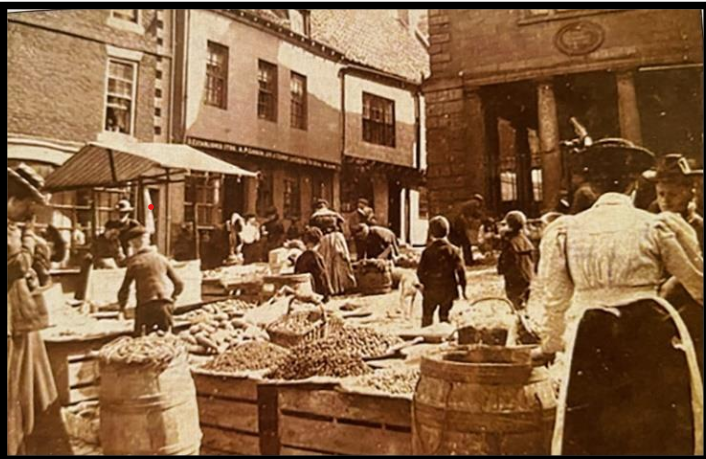
The Romans possibly had a signal station at Whitby as they did at Scarborough, Ravenscar and elsewhere on the Yorkshire cliffs. They made artifacts and jewellery from jet, a fossilised wood from a tree related to the monkey puzzle tree, as the Victorians did, famously, and as craftspeople do now.
St Hilda, a half Anglian, half British royal princess was the first abbess of the Anglo- Saxon double monastery for monks and nuns. King Oswiu of Northumbria founded the abbey in AD657 to give thanks for his defeat of pagan King Penda of Mercia. Not to be confused with the second Abbey, the ruins of which we see today, the Anglo-Saxon abbey had only stone footings supporting timber, wattle and daub walls, improved with more stone over the next two hundred years. A busy place, it immediately became nationally renowned when the Synold was held there in AD 66
The old monastery was repeatedly raided in the 9th Century by Vikings along with the rest of Northumbria and it finally fell to the Danes in AD867. “Streanaeshalch” was forgotten when the Danes renamed the abbey site Prestebi and the settlement below, Witebi
On a windy day in1831 the undertaker John Brown was driving his hearse across the bridge and was blown into the harbour, never to be seen again. In 1835, the first swing bridge was designed and put in place by Jonathan Pickernell’s grandson Francis, after he had finished extending the piers and building the West Pier Lighthouse. Finally, the familiar, electrically operated bridge was opened in 1909 with a 70ft span.
Crossing the bridge, we might turn left to examine the 40% size model of Captain James Cook’s bark the Endeavour. Between 1768 and 1780, Cook’s famous voyages of discovery were made in the flat-bottomed colliers, Endeavour, Resolution, Adventure and Discovery, all built in Whitby, where Cook lived as a boy and young man, and began learning his sea-faring skills.
Ship and boat building was one of the mainstays of Whitby’s economy, from traditional fishing cobbles and luggers to privateers such as the Esk, as well as whalers, convict and emigrant ships and paddle steamers. In the late 18th century only London and Newcastle built more ships than Whitby.
Whitby always had its fishermen. Crabs and lobsters were harvested in the summer, and herring in the autumn, when great fleets of herring boats from the Yorkshire coast and ports around Great Britain, especially Scotland, would follow the shoals southward.
George Stevenson designed that line, which was converted to steam in 1845, when a new station was constructed, which we see today. Whitby was one of the first towns in England to be served by rail, and it became the focus of a very busy network. Railways contributed to the industrial prosperity of 19th century Whitby and the region, by providing means for the economic transport of ironstone, alum, coal and limestone. As well as commercial traffic, the railways transformed Whitby into a thriving holiday destination.
I’m sure many people reading this will recognize the places that Bernard mentioned in his talk.