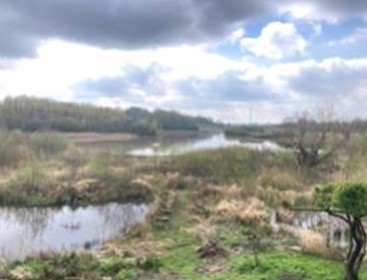
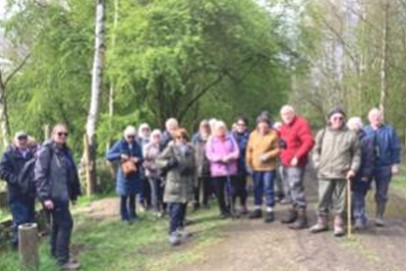
Twenty members met up with Mick Townsend, our guide for the morning, in Nicholson’s farmyard, near Thorpe in Balne before proceeding across the main East Coast railway line into the reserve. Managed by the Yorkshire Wildlife Trust,
Thorpe Marsh lies on the east bank of the River Don flood plain and occupies an area of lowland grassland with patches of oak and birch woodland. Our walk, which was confined to the raised disused railway embankment because the lower pastures were flooded, afforded us excellent views of the water bodies and centuries old ridge and furrows in the semi unimproved grassland. Thorpe Marsh having never been intensively farmed comprises 10% of that type of habitat in South Yorkshire.
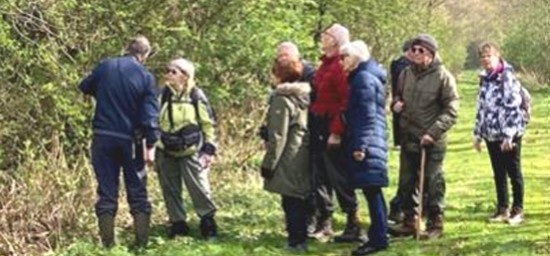
Mick directed us to several bird hides where we also had views across some of the waterbodies. The main body of water was Thorpe Mere, an artificially created pond where we saw greylag geese and tufted duck. Another of the hides afforded views of Applehurst pond which in summer is covered in yellow waterlilies.
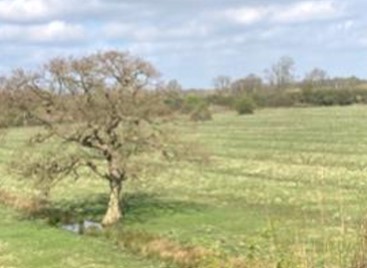
Throughout the morning we heard the distinctive sound of chiffchaff and some of us were lucky enough to see one high up in the trees. A small group were even luckier to hear the sound of a cuckoo. Along the embankment there were a variety of trees including oak which was just about to burst into leaf. On one of the trees we found a group of Marble galls induced by gall wasps and some of the willows were bearing male flower buds with maturing pollen sacs.
Mick suggested that, because of the restrictions caused by recent flooding, the visit be thought of as an introduction to the site and he would be happy to show us more of the reserve at a later date when, hopefully, the lower paths would be accessible. We thanked him for that offer and for sharing his knowledge about the reserve and retraced our steps back over the railway line, grateful for having had the opportunity to visit such an important reserve which has restricted access by car.
Nora Boyle
Photos by Karen Williams